Up through Chapter 1, the fundamental reason your turns are unstable was
Not applying your weight correctly and directly onto the outside foot
That's what I told you.
Then, onto the outside foot 'Apply pressure straight down' What exactly does that mean?
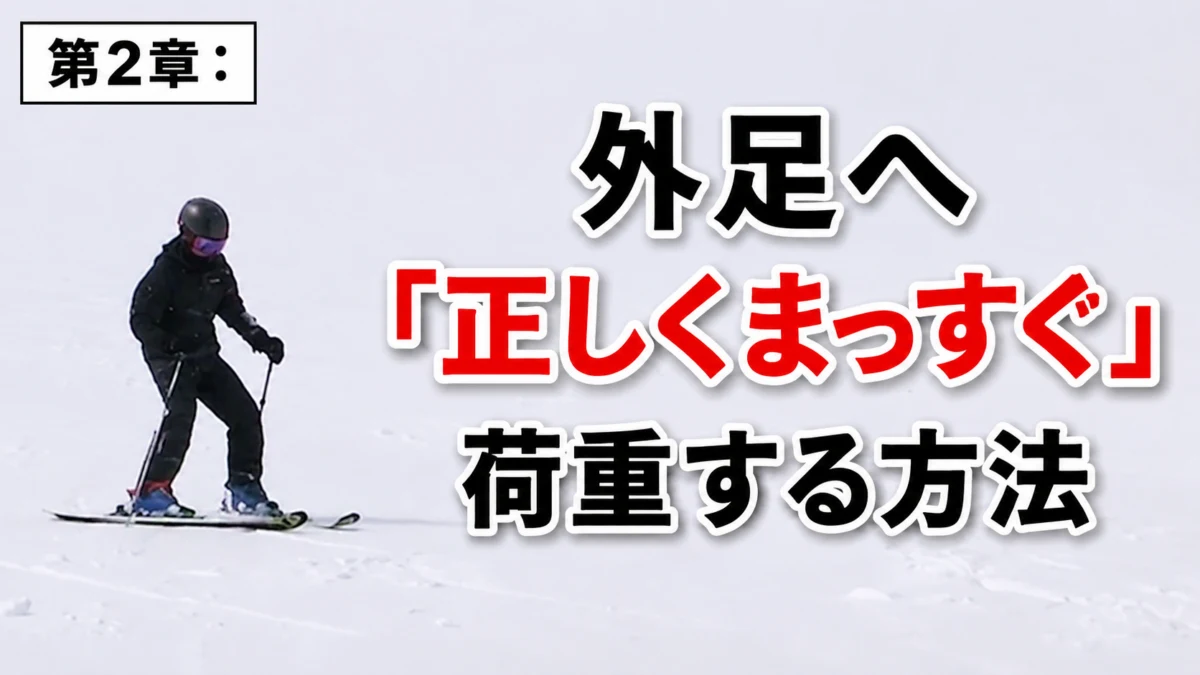
In this chapter, we'll put that method into practice.
To begin with, what does 'applying weight straight down' actually mean?
The state of properly applying your weight directly onto the outside foot is
A state where your body weight transfers directly to the outside ski without escaping elsewhere
That's it.
It looks simple and obvious, but
This is the heart of everything!
Simply put, it means your body is positioned over the outside foot.
To do that, move the following 3 points.
Head, outside shoulder, and outside hip
Move these 3 points toward the outside leg where you want to place your weight.
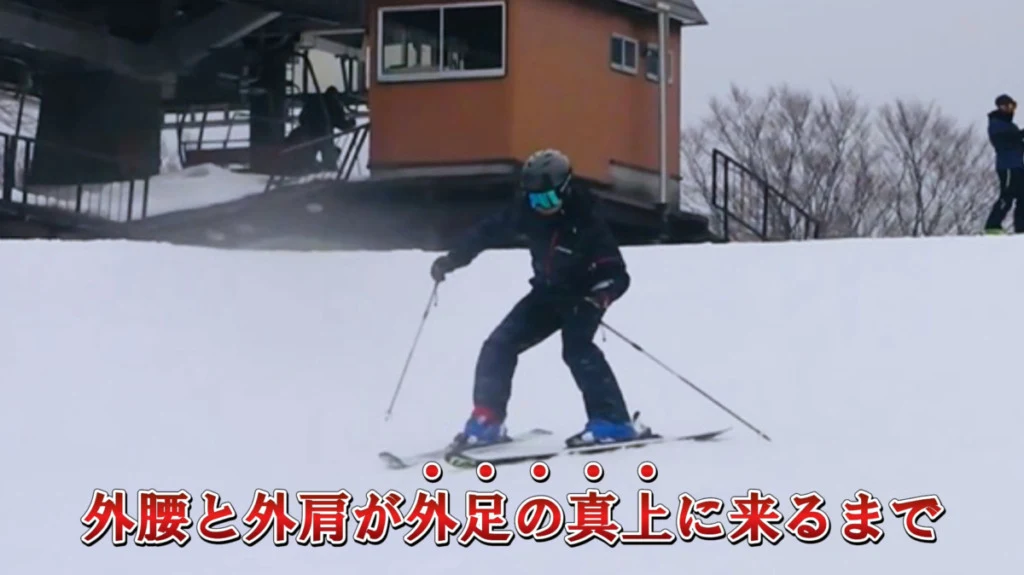
For example, when turning right, your outside foot is your left foot.
In this case,
Bring your head, left shoulder, and left hip closer to the position above your left foot
That's the movement involved.
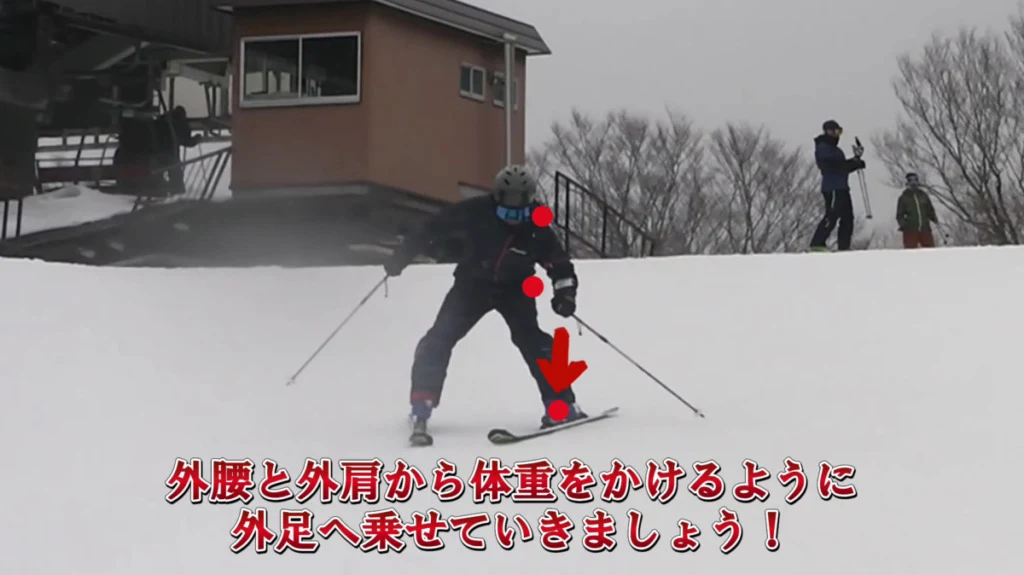
This movement places your body weight onto the outside foot and creates a position where you can transmit force downward onto the skis from above.
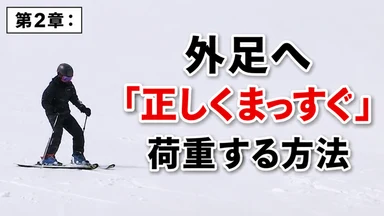
As shown here, start slowly if necessary, but make sure you consistently place your weight straight onto the outside ski. Move your whole body so that your body weight comes directly down onto the outside foot from above.
I'll repeat how important this point is hundreds of times if necessary.
And this is where most of the reasons for failing the SAJ ski certification test lie!
- Poor skiing position
⇒ Not applying pressure directly from above - Poor balance
⇒ Either the head, outside shoulder, or outside hip is out of alignment
In this way,
This also ties into the discussion about position.
There are various interpretations of what position means, but
Where to position your body so your weight transfers directly onto the outside foot
That's how you should think about it.
First, check 'where your weight travels' on dry land
You don't need to start by practicing while skiing.
Especially during the off-season, repeat these physical movement checks until they become second nature.
First, let's check the movement on dry land without wearing skis.
Step 1: Stand with your feet apart
Stand with your feet slightly wider than shoulder-width apart.
Relax your knees slightly, but you don't need to crouch deeply.
Keep your pelvis upright and stand naturally so your hips don't drop backward.
Step 2: Move your body over one foot
First, when putting weight on your left foot,
Move your head, left shoulder, and left hip toward your left foot.
At this point, do not tense your left leg and push forcefully against the ground.
Move your entire body over your left foot.
When you move correctly, you should feel your body weight settling onto the sole of your left foot without having to force your leg muscles.
Step 3: Repeat on the opposite side
Next, Move your head, right shoulder, and right hip toward your right foot.
Repeat this alternately to the left and right, checking the sensation of your weight transferring onto one foot.
What I want you to feel here is
Rather than feeling as though you're forcefully pressing down, feel the weight settle onto your feet as a result of moving your body
That's it.
This difference is extremely important.
3 points for checking whether you're doing it correctly
After performing the movement on dry land, check the following 3 points.
1. Whether the outside hip has moved over the outside leg
Even if you tilt your head and shoulders, you can't put sufficient weight on the outside foot if your hips remain in the center.
The outside hip is especially important.
Whether the hip on the side you're weighting has moved over that foot
Please check that.
2. Whether you feel your body weight on the sole of the foot bearing the load
If you're moving correctly, you'll naturally feel the weight on the sole of the foot bearing the load.
If you can only feel weight on your feet by tensing your legs strongly, you may not be moving your body far enough.
3. Whether the hips are neither dropping backward nor folding forward
If you try to apply weight by bending your knees, your hips are likely to drop backward.
If your hips drop backward, you won't be able to transfer force directly to the skis, even if you think you're standing on the outside foot.
You don't need to crouch deeply.
Move your body over the outside foot while keeping your pelvis upright
Keep that in mind.
On snow, start by checking with wedge turns
Once you've checked the movement on dry land, try it with wedge turns on a gentle slope.
You don't need to start at high speed or with parallel turns.
The goal of this exercise isn't to ski beautifully, but
Confirm the sensation of the skis turning as you position your body over the outside foot
That's it.
This is extremely important, but
Don't push the skis forcefully or twist your feet unnaturally.
Move your body over the outside foot and wait for your weight to transfer to the outside ski as a result.
When you apply your weight correctly, the skis grip the snow and naturally begin to turn.
Trying to stop your descent or twisting the skis before that point is absolutely unacceptable.
Many people do this unconsciously, but
If I were to share just one tip,
When applying weight, you move your center of mass (head, outside hip, and outside shoulder). During this movement, absolutely do not rotate anything below your hips until the skis naturally come around.
Try to practice this thoroughly.
Then, while repeating this alternately to the left and right,
When you move your body over the outside foot, the skis turn naturally.
Check that you can feel this sensation.
What to check when things aren't going well
The skis still skid even when you press down on the outside foot.
Your upper body or hips may be remaining on the inside of the turn.
Before applying force to the outside foot, check whether you've moved your outside hip over it.
Your thighs get tired quickly
You may be pushing the skis with your leg muscles rather than using your body weight.
Instead of bending your knees deeply or folding forward at the waist, keep your pelvis upright and move your entire body over the outside foot.
Only the head tilts outward
If you move only your head, your body will bend while your hips remain in the center.
Not just the head,
Move your head, outside shoulder, and outside hip together
is the key point.
Weight remains on the inside foot
You may not be moving your body far enough.
You don't need to make your movements small from the outset.
First, on a gentle slope at low speed, try making a large movement until you can clearly feel your body weight on the outside foot.
What I want you to remember from this chapter
Outside-ski weighting does not mean pressing hard on the outside foot.
It means moving your body into a position where your body weight passes directly down through the outside foot.
To achieve that,
Bring your head, outside shoulder, and outside hip closer to the position above your outside foot.
First, check the movement on dry land, then practice it with wedge turns on a gentle slope.
There's no need to ski fast or set the skis deeply on edge.
As a result of moving your body over the outside foot, the skis turn naturally.
Once you understand this feeling, it will be your first step toward breaking free from turns that you've been forcing with leg strength alone.