This season, I finally passed SAJ Level 1!
 Naoki
Hello everyone!
I’m Naoki, a Japanese skier who gives skiing his all for life. I specialize in Japan’s SAJ ski tests and have helped many skiers pass.
ski proficiency test SAJ Level 1...
It is the pinnacle of SAJ's grade badge test.
"Because I want to become an instructor!"
"Because I want to challenge myself with the SAJ Technical/SAJ Crown test!"
There are various reasons,
There are a lot of people who set it as a goal!
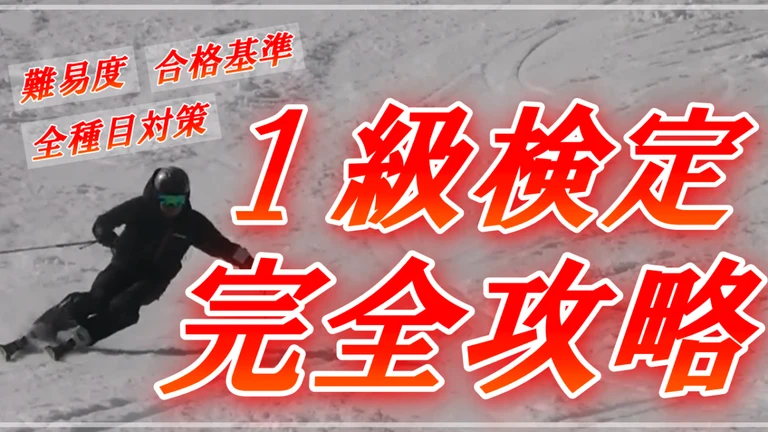
This time, we are dedicated to those who are practicing hard with the goal of passing SAJ Level 1, Key points for passing and exam-specific strategies I'll be explaining it thoroughly!
Surely, "This season, I definitely passed SAJ Level 1!"
I think there are quite a few people who are enthusiastic about this.
For those of you, it will definitely be useful,
"I absolutely want to pass SAJ Level 1 this season!"
With that feeling,
Be sure to read this before the exam! ^^
SAJ ski proficiency test 1 What is a grade? Exam Items and Passing Scores
In a nutshell, SAJ Level 1 of the SAJ ski proficiency test is,
'Proof of an Expert' That's it!
By the way, as a side note...
SAJ Technical is 'otherworldly'
SAJ Crown is 'God' (laughs).
Skiing in four events,
The total score determines the pass/fail.
- parallel turn long-radius turn
- basic parallel turn short-radius turn
- parallel turn short-radius turn・uneven terrain
- a free run combining turn sizes and rhythms (Japanese test event)
*As of the 2020/21 season
Out of 100 points in each category, 70 points are considered passing,
70 points × 4 events = 280 points or higher is required to pass. That's how it works.
However,"By total score" Because it is decided
You don't have to score 70 or more in every event.
Even if there is an event with a score of 69 points (-1),
So, if you get 70 points (+1) in another category, you can pass!
ski proficiency test SAJ Level 1 Key Points for Passing
Key points observed in the certification exam include:
Actually, 2 It's almost the same as the level!
And that's exactly the key point!
'outside foot / outside leg putting body weight on the skis' And 'Position'
Are you able to do the basics of making turns?
That's what the grading test means by thoroughly checking this!
If you want to review the basics of outside foot / outside leg putting body weight on the skis and positions, please check them out here!
So, what is the difference between SAJ Level 2 and SAJ Level 1...
Whether you can get up to speed
When you reach SAJ Level 2 or higher,
The key is how much you can make the most of the board's performance and reach speed!
NaokiOf course, I was so focused on speed that
Going wild is a bad thing... (lol)
In SAJ Level 2, speed control was important to avoid going out of control...
SAJ Level 1 is a skill that allows stable control even at high speed. is required.
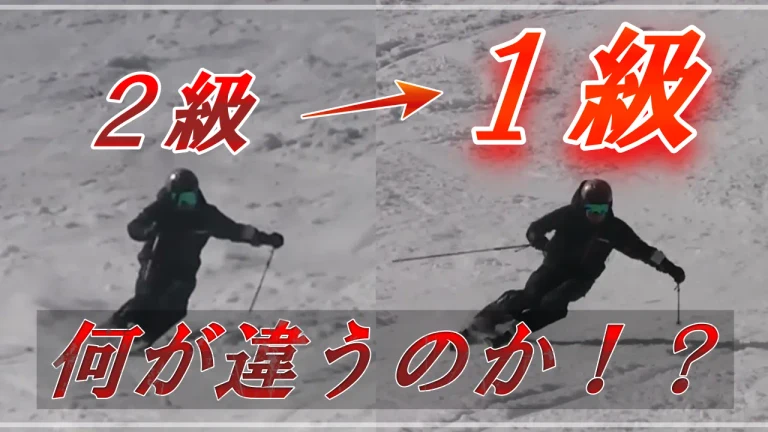
Model ski proficiency test SAJ Level 1 video
First, watch a video where I tried all the SAJ Level 1 test events as if it were the race before the actual test!
In each of the skis,
'Key Points Required for SAJ Level 1'
I keep that in mind!
Please take a look first,
Please take another read after reading the explanation!
SAJ ski proficiency test 1 Level-specific Event-Specific Strategies
Now, let's actually explain the preparation for each SAJ Level 1 event!
I'll explain each event in detail, so if you find a particular sport uncomfortable, feel free to start reading from there! ^^
- parallel turn long-radius turn
- basic parallel turn short-radius turn
- parallel turn short-radius turn・uneven terrain
- Sideslip (discontinued from the 2020/21 season)
- a free run combining turn sizes and rhythms (Japanese test event) (from the 2020/21 season)
ski proficiency test SAJ Level 1 parallel turn long-radius turn
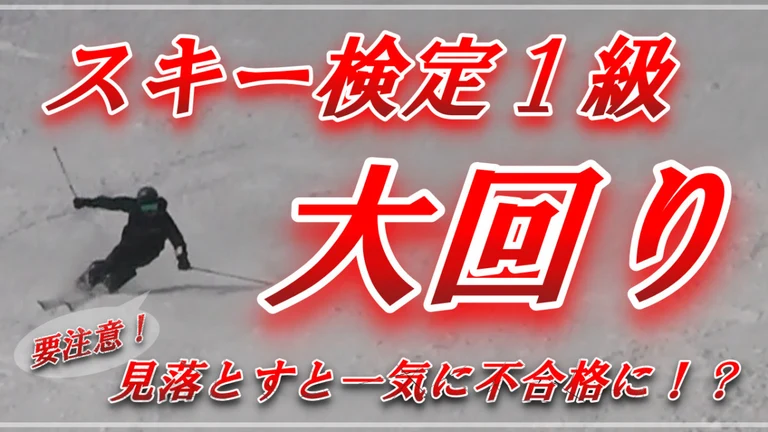
The rhythm is slow on long-radius turn, Even at high speeds, during turns to maintain balance, Maintaining the center position Be aware!
During the transition, instead of standing straight up, Move your center of mass toward the valley side while standing up. This is extremely important!
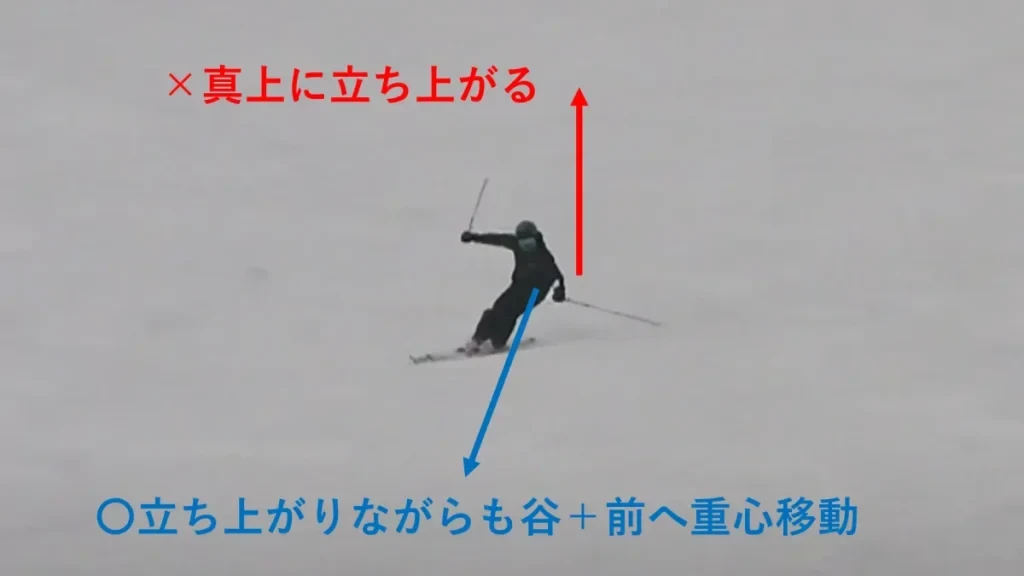
Of course, you need to be careful not to leaning too far inside and losing outside-ski support, but putting body weight on the skis by lowering your outer shoulders firmly to create an outward tilt is also effective.
NaokiI also got into a stable position where I could go a little faster on a steep slope without feeling intimidated, and then I was suddenly close to passing!
ski proficiency test SAJ Level 1 basic parallel turn short-radius turn
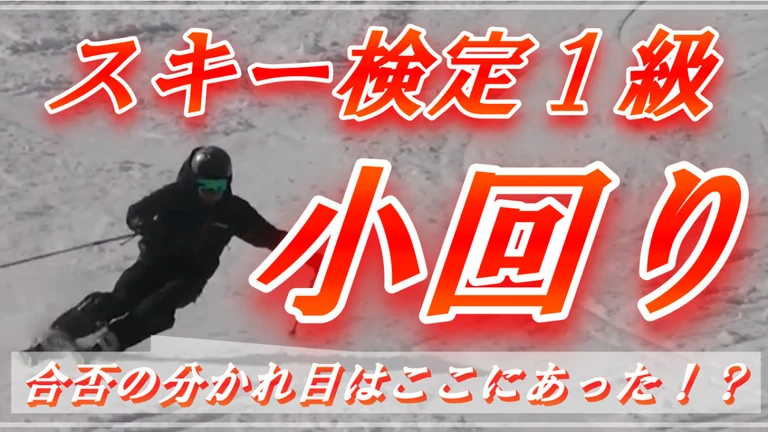
Short-radius turn is also compared to SAJ Level 2...
The difficulty increases dramatically!
Many people probably find it difficult to handle this.
The biggest difference from SAJ Level 2's short-radius turn is
Don't use large misalignments!
That's the point.
The reason you shouldn't use large deviations is...
In SAJ Level 1, I mentioned that glide—that is, speed—is required, but if you use slip, your speed drops in proportion to the amount you use.
Strictly speaking...
If you use too much misalignment,
You won't slow down too much and get a passing score!
That said, it's not that you just have to avoid using the misalignment...
Misalignment is necessary for speed control.
No, what the heck is lol
NaokiThis is just my personal opinion,
I think the outcome depends on the position where you use the offset.
Try to minimize the misalignment in the late turn,
Be mindful of using offset in the first half.
If there is a lot of misalignment in the latter half of a turn, it will result in a braking turn called a wiper, where only the tail is swung sideways.
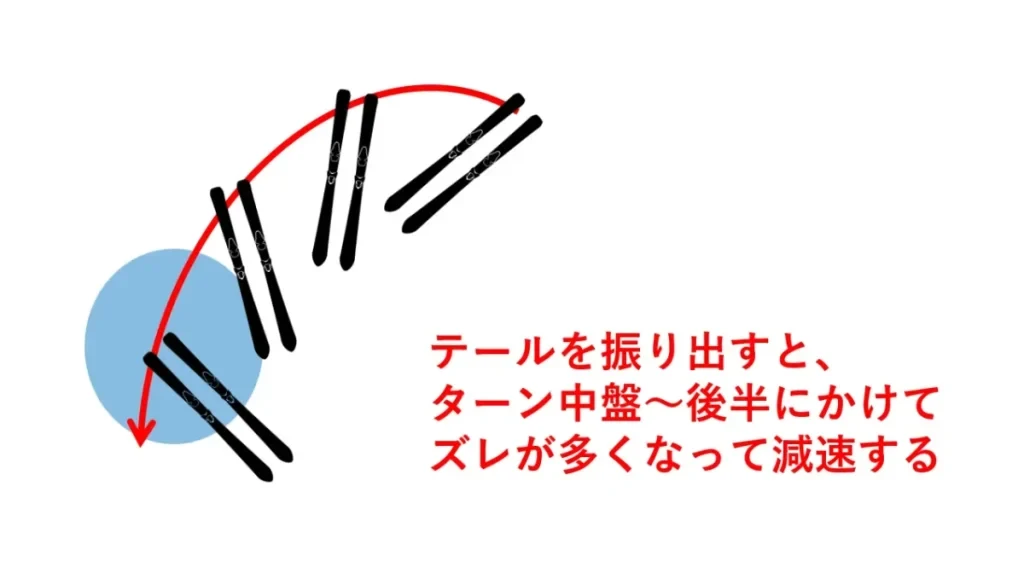
I took plenty of time in the first half of the turn to shift the sliding section, and in the second half, I carving and sliding at speed. Let's aim for it!
ski proficiency test SAJ Level 1 parallel turn short-radius turn・uneven terrain
Finally, it's uneven terrain!
Mogul / bump! The final challenge!!
Many people struggle with SAJ Level 1,
If you stick with this spot, you'll finally be at SAJ Level 1!
These are the points you can see on such uneven terrain,
Broadly speaking, there are four main points!
- Are you able to control the board by shifting it?
- Is the extroversion accurately created?
- Is your stance completely unchanged?
- Is the movement of the center of mass left and right?
The first and second are the basics for skiing through moguls / bump, and many people who don't master these two end up losing control and running off the line.
Especially for those about to challenge mogul / bump,
'Creating Extroversion Correctly→Slide it down and go down slowly.
You can start by leveling the ground and start with this practice,
The recommendation is to just step into the mogul / bump!
Stance is fine even after that!
I'll explain the correct extroversion in detail later in sideslip, but the technique of controlling skis by shifting is the same whether you're mogul / bump or short-radius turn!
First, try sideslipping ➡ transition ➡ directly downward on leveled terrain, and train to keep your sideslip low, focusing on absorption during the transition!
By the way, as a side note...
"uneven terrain" is generally mogul field, but depending on the testing venue, it may not be a regular mogul field but simply a short-radius turn on slightly rough runs.
It's just uneven terrain, after all, lol.
NaokiAnd just for this story...
There's no mogul / bump at the uneven terrain short-radius turn of the giant venue in Shiga Kogen. Also, at my home slope, Akakura, there are mogul / bump, but it's gentle slope! Haha
By understanding the characteristics of each certification venue,
It might be a good idea to deliberately go and challenge yourself there!
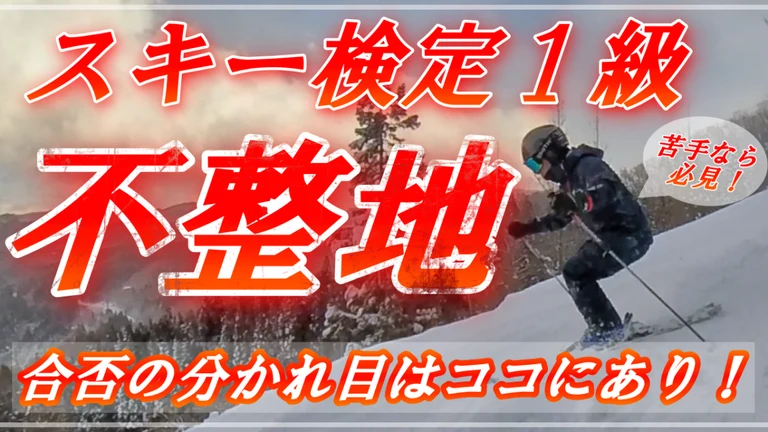
ski proficiency test SAJ Level 1 a free run combining turn sizes and rhythms (Japanese test event) (Started from the 2020/21 season)
Finally, starting from the 2020/21 season, sideslip was discontinued, and in its place, a free run combining turn sizes and rhythms (Japanese test event) was added!
Before sideslip was added, it was a free run combining turn sizes and rhythms (Japanese test event),
It looks like it has returned to its original form!
There is still little information about a free run combining turn sizes and rhythms (Japanese test event),
Key points likely to be seen in the certification exam We have picked out three items!
- Speed
- rhythm changes / changing the turn rhythm
- Acting Composition
Detailed explanations of each are provided separately in this article...
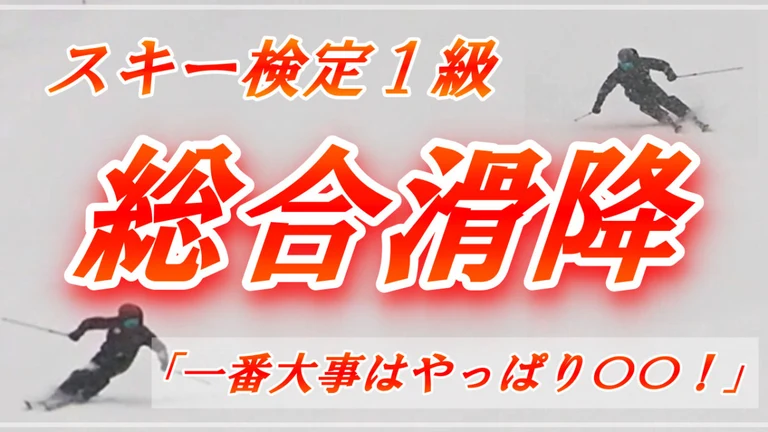
Anyway, there's one thing I can say:
after all kinds The most important thing in a free run combining turn sizes and rhythms (Japanese test event) is, without a doubt,'Speed' That's it!
Even if there are no technical issues,
- Simply slow
- Slowed down by rhythm changes / changing the turn rhythm
- Last to stall
If that's the case, the evaluation is also lacking...
This happens quite often.
To prevent that!
Practice with these 3 points in mind and aim for a high score in the new test discipline! ^^
ski proficiency test SAJ Level 1 sideslip (discontinued from the 2020/21 season)
Although sideslip has been abolished, technically it's extremely important, so let me explain!
It's like, "What is this...?" you know, right? (laughs)
I also found this sport incomprehensible and really hated it.
(Or rather, I still hate it even now.)
There's only one point to see in this incomprehensible sport!
"Correct countered position"
When it comes to sideslip, don't focus solely on the key points to pass SAJ Level 1; instead, deepen your understanding with the intention of laying a solid foundation for other disciplines as well!
By the way, even for short-radius turn and mogul / bump, 'proper extroversion' is essential, so mastering this thoroughly will definitely benefit you in other SAJ Level 1 events as well!
Furthermore, this is an absolutely important point when aiming for a higher level.
NaokiIsn't it starting to feel important? lol
Well then,
"Correct" What does it mean to be extroverted?
To put it super simply,
It means you can shift your body toward the valley!
Since "outward" means "looking outward," looking at the diagram below, the valley side is on the outside of the turn.
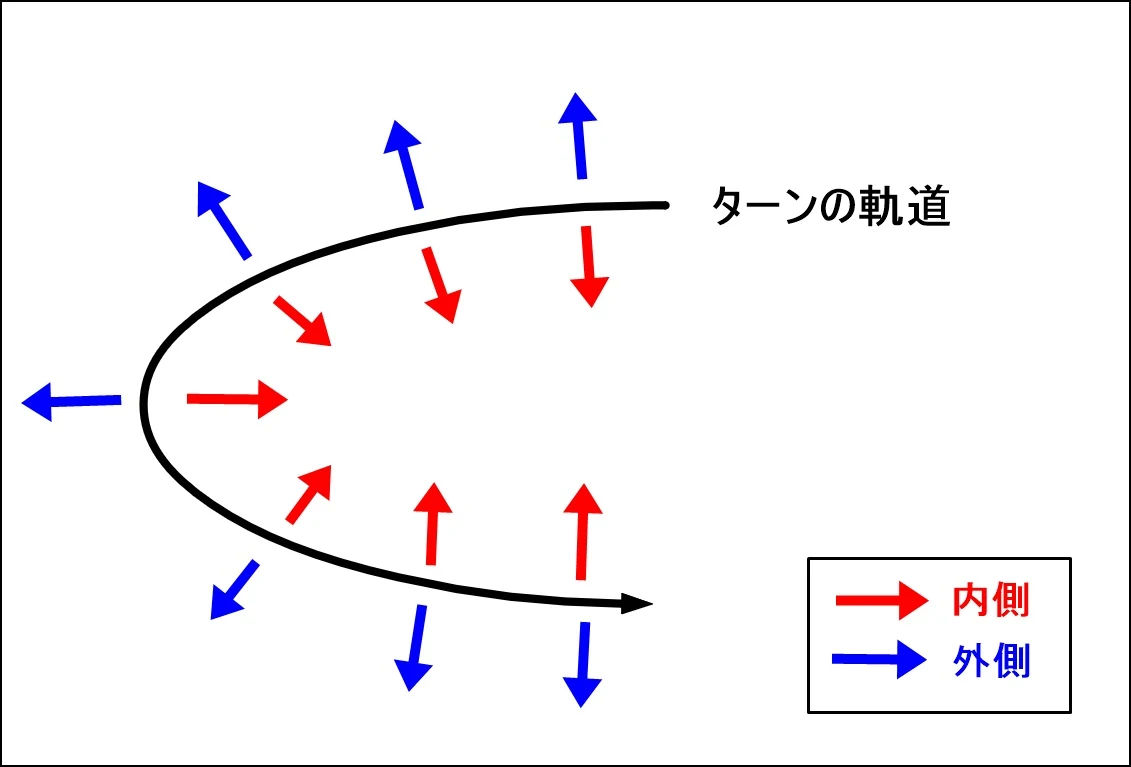
The sideslip state is in the latter part of the turn, so if you look down, green →so it's on the valley side!
If it's a mogul / bump, this spot is especially important,
The foot area is slid or reoriented to match the shape of the mogul / bump, Keep your upper body toward the valley Let's go!
This part is incredibly important,
If I take my time explaining, it would get extremely long, so I've split it into this article.
If you can properly become 'extroverted,'
This allows you to use the misalignment effectively.
If you master the misalignment, your short-radius turn, mogul / bump, and of course, long-radius turn will all improve dramatically!
You really understand how important the basics of sideslip are!
Analyzing difficulty from ski proficiency test SAJ Level 1 pass rates
SAJ Level 1 is at the very top of the grade test,
Of course, it's not easy at all.
Let's take a look at the pass rate for SAJ Level 1!
Here are the statistics on the SAJ ski proficiency test pass rate taken by Naeba Ski School for the 2017/18 season.
| SAJ Level 1 | SAJ Level 2 |
| 21.9% | 32.0% |
First, regarding the pass rate...
Believe it or not, 21.9%!!
By the way, for reference,
Here is the trend in the pass rate over the past eight years.
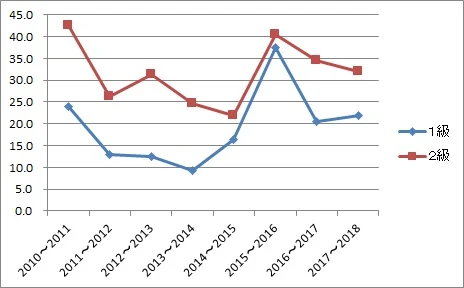
Now, let's take a look at the pass rates by category!
| long-radius turn | short-radius turn | uneven terrain | (Sideslip) |
| 50.4% | 42.5% | 51.1% | 35.4% |
It's surprising that the uneven terrain is high,
The pass rate for sideslip is pretty low~ (lol)
The pass rate for short-radius turn seems to be low as expected.
This is also for reference,
Here is the trend in the pass rates for SAJ Level 1 by category over the past five years.
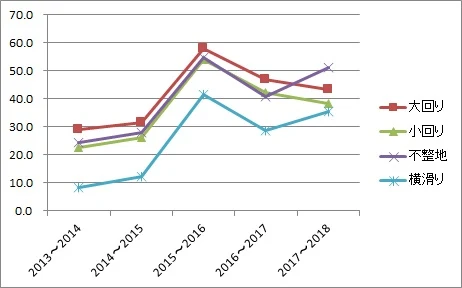
*The scope of aggregation covers badge tests and badge test courses from December 2017 ~ May 2018.
You can also view SAJ Level 2 data, so if you are interested in this data, please check the source page from the link below!
2017~2018 Badge Test (SAJ ski proficiency test) SAJ Level 1~SAJ Level 2 Pass Rate and Other Data
The process leading up to the ski proficiency test SAJ Level 1 entrance exam
Unlike SAJ Level 2,
1 Prior training is mandatory for each class.
- Morning: Pre-class Seminar
- Afternoon: Actual Certification Exam
That's the general flow.
In the morning, I checked in for the certification at the ski school,
We gathered at the meeting point for the pre-training and started the lesson.
After lunch, gather again at the designated location to start the exam.
[Latest revision from 2024/25] ski proficiency test SAJ Level 1: Changes to examiners and scoring
*This is the latest update from the 2024/25 season
First, let's talk about the examiners and the grading content!
Regarding the examiners,
The number of graders has changed.
What is the content...
SAJ Level 1 examiners can now conduct it with two people!
What will change with this is:
Unbelievably...
Your pass rate will increase!
What I mean is,
Previously, the average of the 3 scores, rounded to a whole number, was used to determine a pass. In practice, this meant that at least 2 judges had to award passing marks.
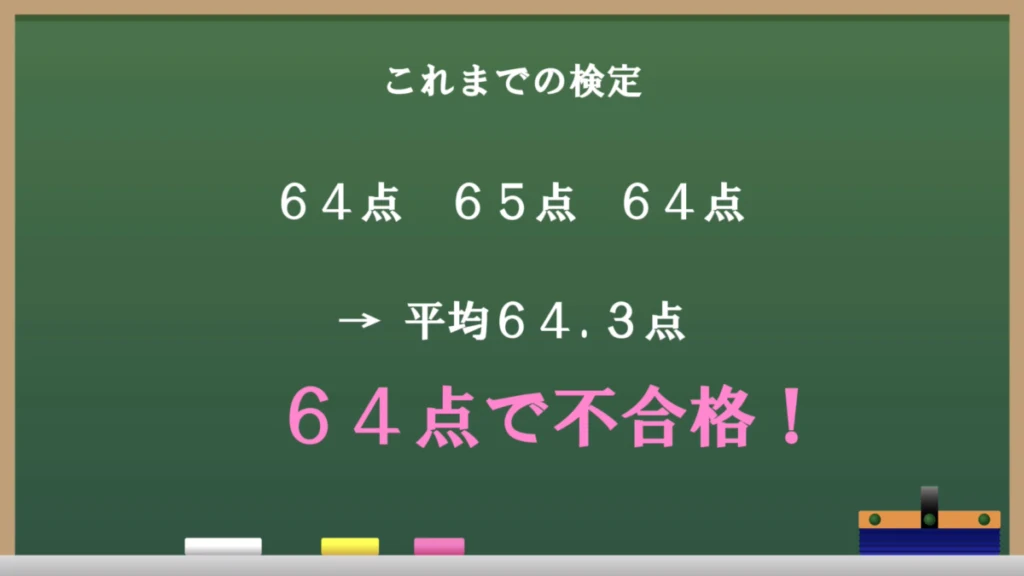
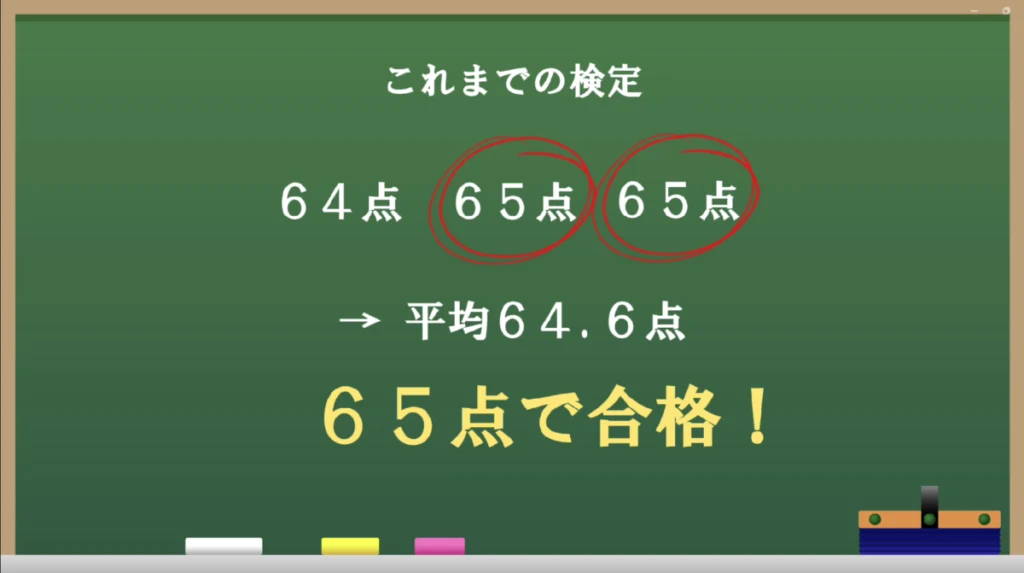
However, if even one person gets a passing score because the average is the average of two people, even if one person gets a point deducted, the decimal point is raised by ".5" to pass.
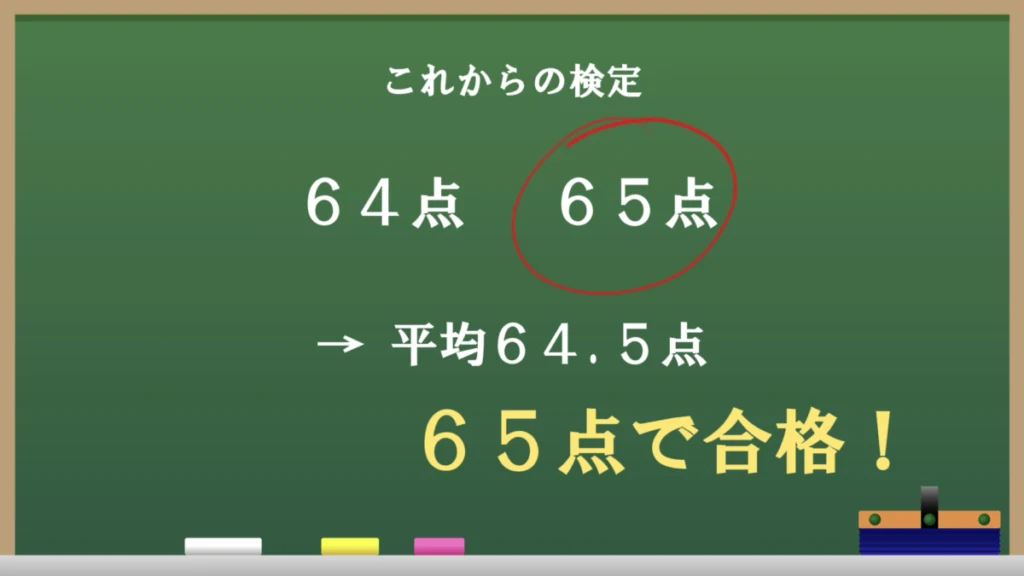
From the above, if you think about it normally,
This was considered an improvement in the pass rate.
SAJ ski proficiency test 1 Summary of Grades
Now, let's summarize the ski proficiency test SAJ Level 1 certification exam!
- The main points examiners look at are basically the same as SAJ Level 2: 'outside foot / outside leg putting body weight on the skis' and 'position'
- A long-radius turn means maintaining a stable center position!
- For short-radius turn, try to minimize misalignment in the latter half of the turn and use it in the early half!
- Mogul / bump is made outward and slid firmly!
- For a free run combining turn sizes and rhythms (Japanese test event), speed comes first!
- The key to sideslipping is the 'correct' extroversion.
So, this time we have explained the key points for passing SAJ Level 1. What did you think?
Once you reach SAJ Level 1, it's no longer a level where you can get through with superficial techniques!
Therefore, if the basic foundation is not solid, it quickly becomes a "deductible skiing."
Although this is the pinnacle of the ranking test, don't just look upward—sometimes look back and check your outside foot / outside leg putting body weight on the skis and position!
NaokiThis is also based on my own experience,
The key to escaping a slump is often the most fundamental part when you're struggling! lol
感想や質問があればお気軽にどうぞ!
8件のコメント