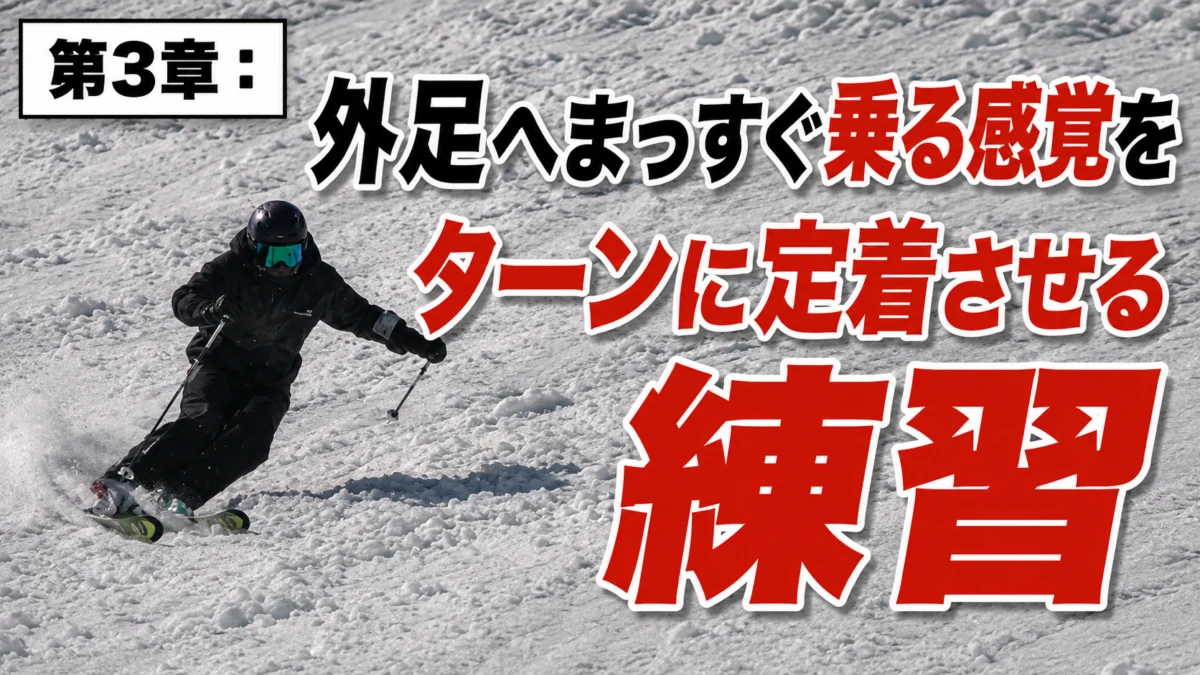
In Chapter 2,
Rather than pressing hard on the outside foot, move your body into a position where your weight transfers directly onto it.
That's what I shared.
From here, we'll work on applying that movement to actual turns.
However, you don't need to start practicing with linked turns immediately.
In actual linked turns,
- Transition into the next turn
- Adjust your speed
- Follow the movement of the skis
- Check your surroundings.
You have to do several things like these simultaneously.
Then it becomes difficult to focus on standing on the outside ski, and you tend to revert to your usual habit of forcefully turning the skis with your legs.
So at first, we'll separate the turns and practice them one at a time.
The goal of this chapter is not to make beautiful linked turns.
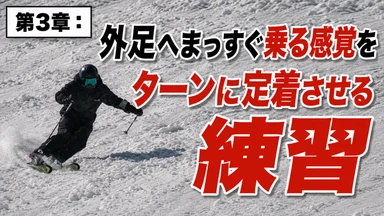
Develop the sensation of the skis turning naturally as a result of moving your body over the outside foot.
Focus only on this.
Practice 1: Make Just One Turn
First, choose a wide, uncrowded gentle slope.
Start in a snowplough position without building up speed.
Check that your surroundings and the slope above you are safe before trying this.
Once you start skiing at low speed,
Move your head, shoulders, and hips over the outside foot.
At this point, do not twist your feet to change the direction of the skis.
There's no need to push hard either.
Move your body over the outside foot, then wait for the skis to start turning naturally.
When your weight is transferred correctly to the outside ski, the ski will turn naturally.
Continue through one complete turn until you're facing sideways across the slope, then stop.
Why do we stop after every turn?
By stopping after every turn,
Did the skis turn because you moved your body, or because you twisted your feet?
It will become easier to check that.
In linked turns, momentum and rebound can carry you into the next turn even without proper movement.
As a result, you can manage to ski somehow even without properly standing on the outside ski.
However, when you carefully perform just one turn, there's no room to hide mistakes.
If you aren't properly balanced over the outside foot,
- The skis don't start turning
- You feel tempted to turn your skis sideways suddenly
- Weight remains on the inside foot
- The upper body leans inward into the turn
Things like that happen.
That's precisely why we first make sure to execute one turn properly.
Practice 2: Wait Until the Skis Turn
Even when you think you're weighting the outside foot, if the skis don't turn easily, you'll quickly feel tempted to twist your feet.
However, if you rotate the skis here, you'll just be skiing the same way as before.
Once you've moved your body over the outside foot,
Don't try to turn the skis yourself. Wait until they begin to turn naturally.
When you put your weight on carving skis correctly, their shape naturally makes them turn.
What we want to check in this exercise is
Even without deliberately changing the direction of the skis, they will turn when you stand on the outside foot.
That's the feeling.
It's fine if your turns are large at first.
Prioritize whether you were able to turn by standing on the outside ski, rather than trying to perfect the shape of the turn.
And make sure you resist moving anything below your hips until the turn actually begins.
If you do that,
This results in twisting the skis, undoing the natural turn you had created by applying your weight directly and properly onto the outside foot.
Practice 3: Gradually Narrow the Snowplough Stance
Once you can stand on the outside ski during wedge turns, gradually narrow the snowplough stance.
Here too, we won't change how we use our bodies.
- For a right turn, move your head, left shoulder, and left hip over your left foot
- For a left turn, move your head, right shoulder, and right hip over your right foot.
When you narrow your stance, it's harder to conceal mistakes than in the snowplough position.
As you narrow your stance and increase speed, make your movements larger instead.
If you aren't properly balanced over the outside foot, the inside foot may get in the way, or your body may lean inward.
On the other hand, when your body weight is on the outside foot, the inside foot becomes lighter, making it easier to bring the inside ski closer to the outside ski without forcing the movement.
However, don't make keeping your skis parallel your top priority.
Standing directly on the outside ski comes before trying to create a parallel stance.
If your movement onto the outside foot breaks down, go back to the snowplough.
In reality, it's quite unremarkable, but
Carefully reviewing these movements with snowplough turns will naturally help you improve the quality of your parallel turns.
Even for advanced skiers at SAJ Level 1 or above, consistently and thoroughly practicing these seemingly unremarkable fundamentals is precisely what leads to truly mastering pressure on the outside ski and improving your skiing.
Let's make a conscious effort to apply what we discussed this time!
3 changes that occur when you're doing it correctly
Once you can apply your weight directly onto the outside foot, you'll start noticing the following changes in your skiing.
1. The outside ski becomes less likely to wobble
Because your body weight is transferred to the outside ski, the ski becomes stable against the snow surface.
You'll begin to feel the outside ski suddenly slipping outward or rapidly wobbling less often.
2. The skis turn without having to forcefully rotate them
Even without twisting your feet, the outside ski naturally begins to trace an arc.
You no longer need to turn your skis sideways suddenly, making your turns smoother.
3. Less unnecessary tension in the legs
You'll learn to use your body weight rather than pushing the skis with leg strength alone.
As a result, unnecessary tension in your thighs decreases, allowing you to make turns more easily than before.
When things aren't going well, don't make the exercises harder
Even if your speed increases or your turns become unstable during practice, don't try to press harder on the outside foot.
At that point, the exercise is too difficult.
- Move to a gentler slope
- Reduce your speed at the start
- Widen the snowplough stance
- Stop making linked turns and return to practicing a single turn
This creates a situation where you can focus solely on moving your body toward the outside foot.
You'll improve faster by learning the correct sensation on an easy slope than by forcing yourself to repeat the movement on a difficult one.
Summary of Chapter 3
You don't need to complete linked turns right away to learn how to apply your weight directly onto the outside foot.
First,
- Perform just one turn
- Move your body over the outside foot
- Wait for the skis to turn naturally
- Once you can do it, gradually narrow the width of your snowplough.
Practice in this order.
The goal isn't to create turns by forcibly twisting the skis.
It's a turn in which the skis turn naturally as a result of positioning your body over the outside foot.
To make clean carving turns at high speed, the key isn't skillfully manipulating the skis. It's being able to stand naturally on the skis as they descend, without making unnecessary movements.
The more you're struggling to improve, the more you should check whether you're forcing unnecessary movements onto the skis during your turns!
If you can reduce unnecessary movements or forces applied to your skis by even 1%, there's no doubt that the quality of your carving turns will improve dramatically!
Please give it a try this season!