 Naoki
Hello everyone!
I’m Naoki, a Japanese skier who gives skiing his all for life. I specialize in Japan’s SAJ ski tests and have helped many skiers pass.
I have previously explained about the short-tune body.
Click here for the article!
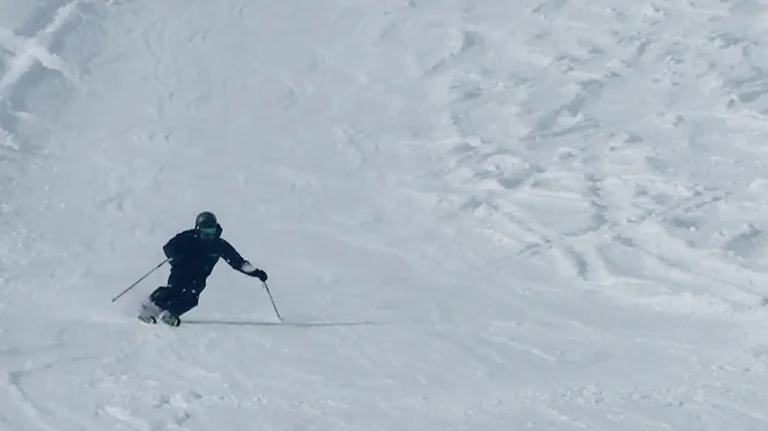
To summarize the contents briefly,
In the end of the turn, by turning the upper body to a fountain point against the movement of the foot, it is actually moving but it “look” as if the upper body is stopping.
In this way,
It doesn't seem to be moving though
In fact, you have to keep moving
We talked about that.
I had to talk about the end of the round, but this time. Twisting in the first half of the turn I would like to talk about it!
This time, we will talk about the first half of the turn and how to use the body.
2 I would like to introduce you to some kind of shortcut!
- large size short turn
- small size short turn
Simply said, the turn size is different. 2 Some kind of short turn,
I want to explain how each body is used in order to have a drawback of technology that can be shared by the situation of Burn and the trend of the conference's score!
I was very good when Bern was good, but if it was a booko or calicali, it would be quite good that I could not get the normal sliding at the end.
In fact, it still exists (lol)
In exams, especially when it comes to SAJ Technical/SAJ Crown tests,
Are you able to skate according to the conditions?
This is also seen as a severe issue.
When you get a good feeling like I did,
If you only practice skating with that feeling,
It fails because it cannot deal with the burn situation...
The purpose of this article is to
“If the situation is today, what short turn will we go? 」
The idea is to create a drawer where you can choose!
“I could have passed if Burn was good…(><)”
So that's not going to happen, keep the knowledge of technology in mind towards season and practice to increase output!
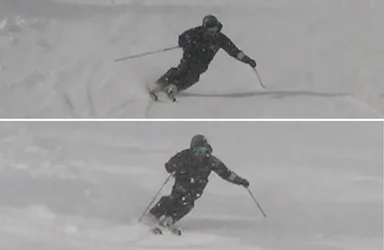
Short turn with downhill distance between turns in a large space
and then 2 Looking at the video of my short-turn training last season,
We will tell you how to use each first round of the body!
This is a good time for snow!
To summarize the main points about this slippage,
For when the snow conditions are good,
The upper body and the shorter turn size are also large, with a small downnhill distance between turns.
By pushing out skiing with your whole body,
Take the distance between center of mass and ski to control.
The first half of the turn is a way to use the upper body close to long-radius turn.
In other words, turn your upper body slightly as you enter the turn.
There is no way to get rid of it, as long-radius turn will be a move that can follow up the foot movement in the entrance.
In this case, the upper body and lower body will be turned in the same direction, so imagine the turn point as the position around your chest. And then, the end of the turn is to be turned on a side (to the reverse).
"Short turn with up and down fulcrum"
I can say it!
It is great to use your body, but if you don’t take a strong downnhill distance between turns, it can also not come down quite well and look like a slowly unspoiled slide.
Also, if you turn your body too much in the first half, it looks like a bad short turning of speed because the turn size is too big and so here you are also careful!
Short turn with less downhill distance between turns in small space
I think you could have a little bit smaller to the turn size.
Look at the difference between the big shorts and short turns!
The explanation will be the opposite of the previous one.
That means,
For when the burn situation is not good
Don't get the body far from a short turn.
That is.
And in that case,
This will result in a relatively small turn arc.
Whatever operation you do, you don’t get skiing too far from your body and put it under your body using a lot of hip/hip joint scratches. I always have my feet from hip/hip joint.
So,
"Short turn with the fulcrum at hip / hip joint"
You can also say that.
The first half of the turn is not as upward as before. This is probably a good idea for the “sustainable side of the valley”.
And in this case, the foundation always taps the low position around the hip/hip joint. From the first half of the turn, hip/hip joint as a foundation toward upper body and lower body in the reverse direction, this is also the opposite when big size.
2 type of short turn summary
like this. 2 I’ve explained about the kind of short turns, but let me put it together easily in the end.
① Large size short turn
・When the burn situation is good
・Turn your upper body in the first half of the turn
・In the first half of the turn, the fulcrum is in a high position
② Small size short turn
・When the burn situation is bad
・Stop upper body in the first half of the turn
・The fulcrum is at a low position from the first half of the turn
So, here is 2 two short turns,
I explained how to use the upper body according to the sliding.
"When the size is large, turn your upper body."
“When the size is small, stop your upper body.”
That's what I meant.
Just if you choose any short turn, the end of the turn will definitely be reversed!
This will be a common technique for short-tourn, so let’s first complete the final round.
And then, if you adjust the turn arc and the level of turning up the first half of the turn that corresponds to it is OK! And this is a very advanced technology, but you can also adjust it while feeling the reaction from the snow side during skiing.
This time, we’re talking about the “crowd”. 2 We have explained about the types of short turns, but there are many ways to classify short turns!
Regarding the content of this time,
We have created the most powerful short-tune article that has been powered!
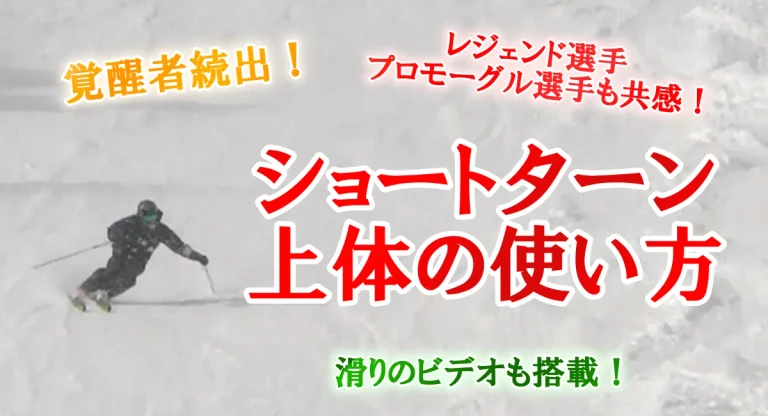
There is no other detailed content that has been cut out alone about how to use the short-to-round upper body so far! I can confirm!
I'm going to create useful content, so please follow my account.
See you next time!
Please watch until the end,
Thank you very much!
感想や質問があればお気軽にどうぞ!
0件のコメント