Directly facing long-radius turn? Extrovert?
 Naoki
Hello everyone!
I’m Naoki, a Japanese skier who gives skiing his all for life. I specialize in Japan’s SAJ ski tests and have helped many skiers pass.
This time, skiing's trouble consultation series!
This series will be presented in my question box, especially on the steps and details that need to be explained!
If you have any questions you would like to ask Click here From!
Please feel free to ask me anything ^^
So,
I will answer you this question in the box of questions and what is interesting!
The question is here▼
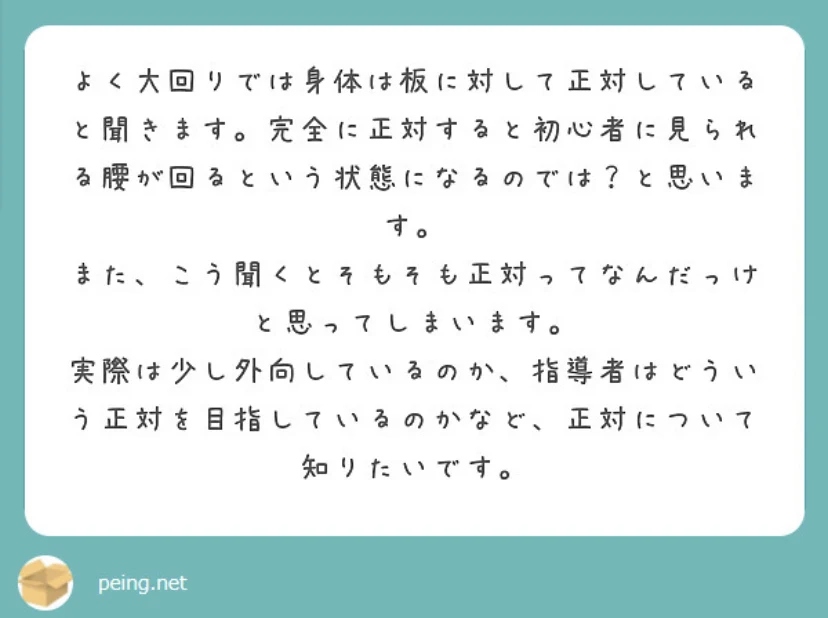
It’s about the long-radius turn.
When we say “face-to-face” or “extroversion,”
The term long-radius turn is commonly used.
These two terms are often misunderstood, but
This time we will also explain the direction of long-radius turn!
[Glossary] “Face-to-face” and “Extraversion”
First of all, as the questioner said,
“What exactly does it mean to be directly facing each other?” From that point right!
The terms “direct facing” and “extraversion” are
If you don’t understand it, you will continue to cause a huge misunderstanding that is always going to be pulled out.
NaokiThat's exactly how I was...
First, we’re going to start with the “right” and “outward”. ^^
What is the opposite?
First of all, it's "directly facing"!
The word “adversary” means “front to face”. The direction of the ski and body are in the same direction. That means.
Strictly speaking, it doesn't necessarily mean [your hips turn → facing directly].
▼Please also refer to this explanation!
What is extroversion?
Extroversion is literally "Facing outside the turn" That's it!
For inside and outside turns:
If you have this image, it’s OK.
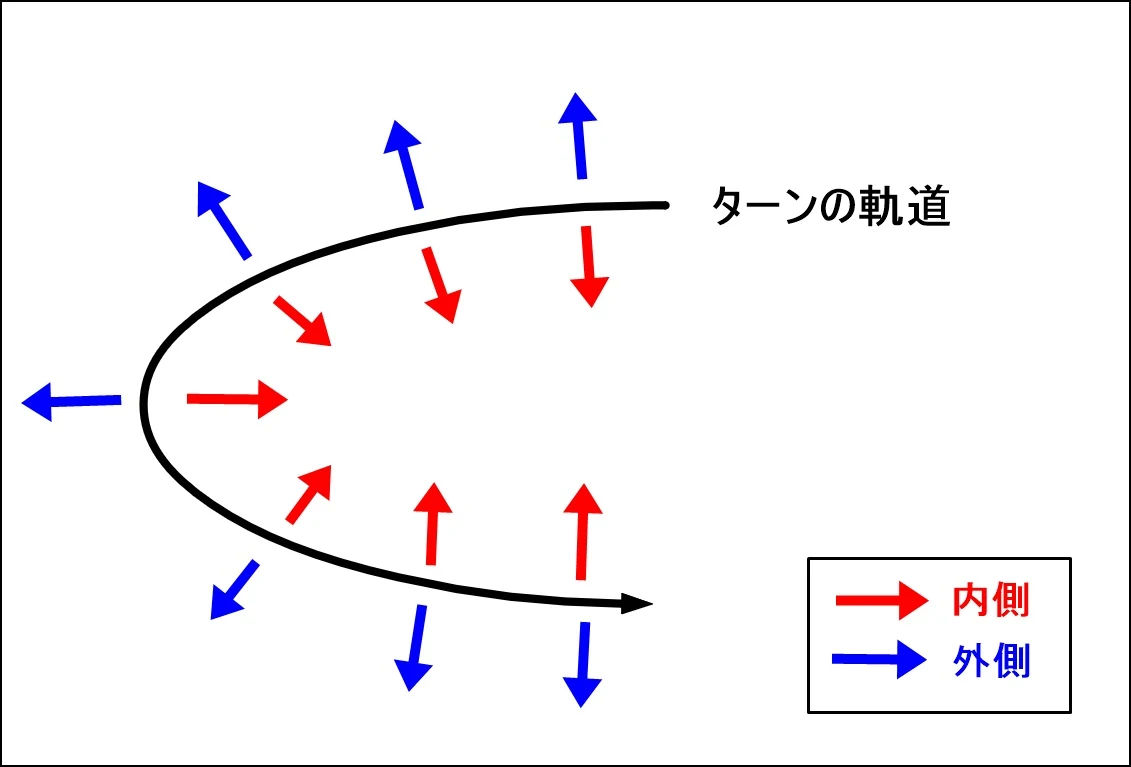
Turn in the direction of the blue arrow. extroversion That's what they say.
By the way, the direction of the opposite red arrow is upper body facing toward the inside of the turn relative to the skis That's right.
Now, about this facing and extroverting,
I'm going to tell you how it comes in the long-radius turn!
long-radius turn's expression "body orientation" was a problem! ?
Is it possible to see the full-fledged beginner?
This is exactly what you say!
It's confusing, but
×Hips turn → facing directly
○Directly facing → waist turns
That's how it works.
My answer is Cochila!
Well in skiing "Body orientation" I think this is a very difficult word, but it makes me feel uncomprehensible!
The reason is that
What is the direction of the body?"The direction of the waist" Or "Direction of upper body" Because the meaning changes greatly depending on the meaning!
Because the upper body and the back are moving differently.
We cannot discuss whether it is “positive” or “external”.
Let's see why!
long-radius turn will never face you completely!
In long-radius turn, is the body facing directly or outward?
My answer to your question is,
Both in the first half and the second half of the turn,
long-radius turn will never be completely opposite!
In other words The hips of upper body and skiing are not in the same direction. That's what it means!
Because,
Even if your hips are facing directly,
upper body should not be oriented in the same direction.
This is because there are many situations where this happens!
What about the upper body or the back?
This will be explained in the next section!
If I had to say so,
It is about a moment to turn down in the middle of the round.
There are individual differences here,
I have a little bit of the image to make it up for me at this moment!
long-radius turn is an extrovert!
Then we will explain the “slip-to-back” and “upper body” in long-radius turn!
In the previous paragraph, we explained that long-radius turn does not match upper body and back completely, but for senior people. hip orientation is especially important!
Here we will summarize the long-radius turn’s valley round, the second part of a turn, after the fall line on upper body and backward!
upper body and hip direction around the valley
The most difficult part is around the valley.
The direction of the waist is opposite to upper body!
- upper body・・・upper body facing toward the inside of the turn relative to the skis
- Waist...extroversion
That's how it works.
So, is Long-Radius turn outside? The opposite? I'm a little bit troubled to answer your question. ( laugh)
Upper body does not always mean that upper body facing toward the inside of the turn relative to the skis, but some people are going into a turning way outside. The key is to keep your hips facing outward!
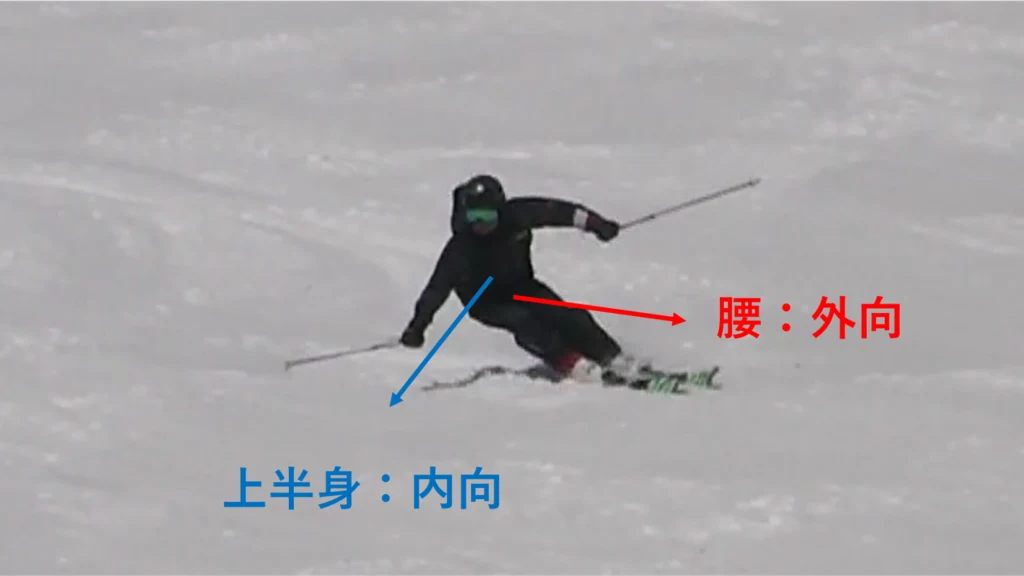
With a very hard position, it may be difficult to create this position when you get into the turn until you get used.
If you can, it will be easier to get the snow on this side of the valley!
upper body and hip orientation in the second part of a turn, after the fall line
the second part of a turn, after the fall line has a slightly different point.
- upper body・・・Strong extroversion (downward)
- Waist...extroversion
In the end of the round, upper body will be important!
upper body and the waist are still turned outward, The upper body is weak. The volume of the rotation is small.
It is good to feel that the back is not going to turn right on the board, but it's NG to turn upper body in line with the back!
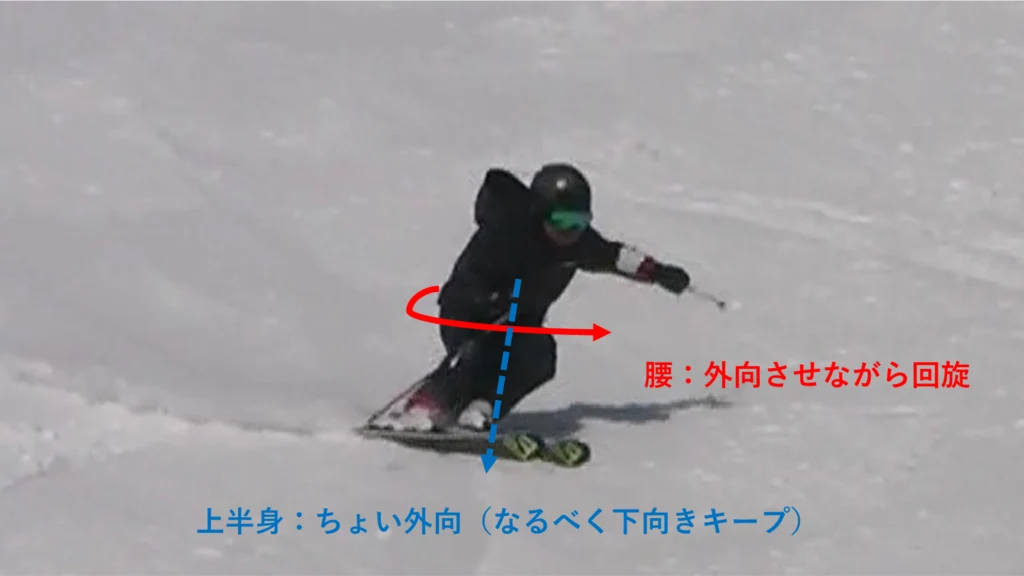
I’m rather upper body to keep moving towards the valley as much as possible and feel like it is enough to be able to turn!
The ability to withstand this rotation becomes "tame",
This is important for running skiing!
[Summary] long-radius turn's body orientation
Now, here's the summary for this time!
- If you say the body is upper body and your back are different.
- With long-radius turn, it is unlikely that you will be completely facing each other!
- Around the valley, upper body → upper body facing toward the inside of the turn relative to the skis, waist → outward
- In the second part of a turn, after the fall line, upper body → slightly extroverted, hips → extroverted
- For the second part of a turn, after the fall line, keep upper body as far down (valley) as possible
So,
What did you think?
The more advanced you become, the more
How you use your body other than your feet is very important!
So, is it just right? to the outside? I can’t talk about it, so this time I have to explain each one!
I am glad you can get a little bit up your level, my friend.
So that's all for today!
I have also been reading the past story, so you can see it here!
▶︎skiing trouble consultation series
Let us see you again the next time!
Please watch until the end,
Thank you very much!
感想や質問があればお気軽にどうぞ!
0件のコメント