Hello, everyone!
I’m Naoki, a Japanese skier who gives skiing his all for life. I specialize in Japan’s SAJ ski tests and have helped many skiers pass.
Now, over 3 chapters, I'll explain all the fundamentals of weighting that form the foundation of every lesson and course I teach.
Let's get straight to the main topic.
- Become unsteady during turns
- As speed increases, you become afraid and tense up
- Carving turns remain unstable even though you're edging the skis and leaning your body
There's something I want people struggling with these concerns to understand first.
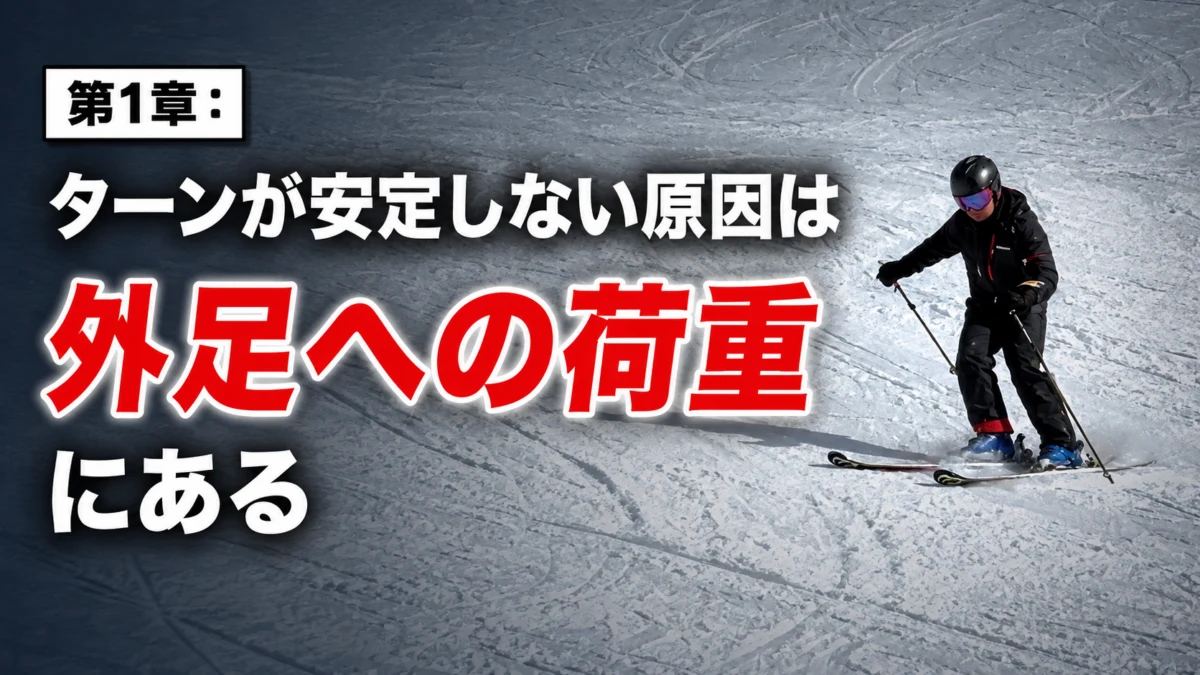
The fundamental reason your turns are unstable is
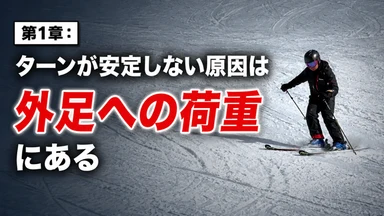
Not applying your weight correctly and directly onto the outside foot
When I talk about weighting,
I always make this the foundation of every lesson and course.
Edging the skis, leaning your body, and adjusting your fore–aft position are not wrong.
However, all of these are intended to help you properly put weight on the outside ski "Means" That will be the result.
Even if you put the skis on edge while your body weight isn't properly transferred to the outside foot, your body won't be able to receive the reaction force from the snow.
You may manage to ski at low speed, but as you accelerate, the skis move away from your body and your turns suddenly become unstable.
That's precisely why, in this lesson,
I'll teach you the most fundamental basics for making stable turns, even at speed on steep slopes.
I kept it concise and simple so you can understand it quickly and try it out immediately.
Whether it's ski season or the off-season, be sure to try it after you finish reading.
'Pressing down on the outside ski' and 'standing on the outside ski' are different
First, something people often confuse is
Pressing down on the outside foot and standing on the outside foot are different.
That's what it means.
Pressing down on the outside foot means using the muscles of the outside leg to apply force through the foot.
On the other hand, standing on the outside ski means shifting your actual body weight over the outside foot.
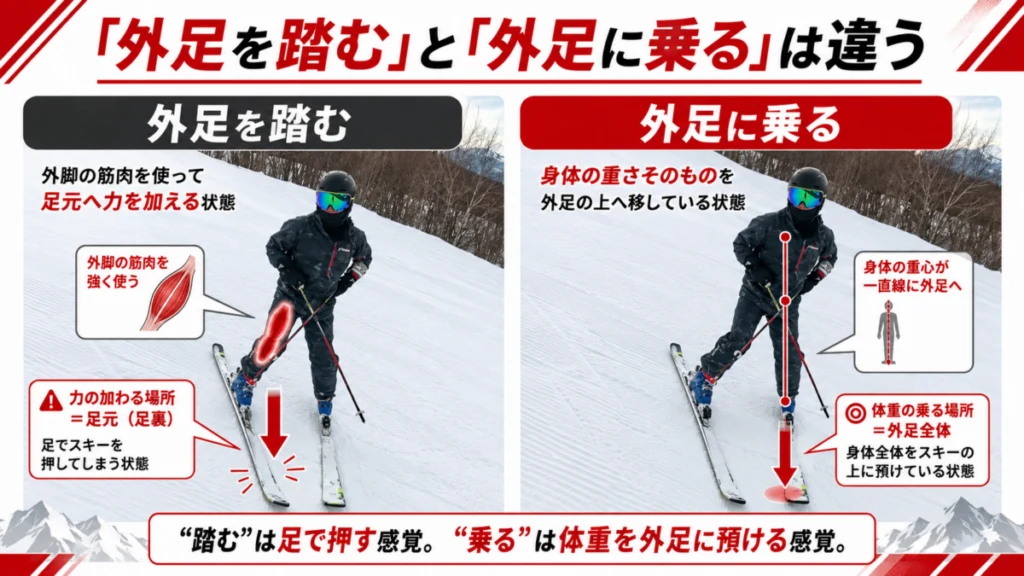
If your body remains over the inside foot or behind, pressing hard with only the outside leg won't fully transfer your body weight to the outside foot.
- There is force in the outside leg
↓ - Your thighs also get tired
↓ - Even so, the turns are still unstable
This may mean that you're not actually standing on the outside ski, but simply bracing yourself with your outside leg.
Outside-ski weighting is not a technique of pressing the ski down with leg strength. It is a technique of shifting your body weight (center of mass) over the outside foot and transferring that weight to the ski.
First, this forms the foundation of everything.

No, I understand that part, but...
You might have thought that, but
'I think that's probably the case.'
I'm sure those of you who follow my content already understand that putting weight on the outside ski is the most fundamental and important principle, and also know exactly what you need to do in practice.
However...
Very few people can actually do it
That's the reality.
From what I've actually observed, many people who fail the SAJ ski certification tests haven't sufficiently mastered outside-ski weighting.
There are various causes and ways to describe them, but
All of these are intended to help you thoroughly master proper pressure on the outside ski.
Without understanding that,
'Each person has their own reasons for failing'
You may be fixated on complicated technical ideas, but ultimately, the fundamental reason people fail is the same: they haven't thoroughly mastered the turning fundamental of putting weight on the outside ski.
Many skiers fail to notice this and instead seek complicated explanations or brand-new techniques, but their skiing will never change that way.
And even I don't say things this harshly in my public content.
That's why I want everyone taking this course to first thoroughly resolve the issue of putting weight on the outside ski, a challenge shared by everyone struggling with their skiing.
Narrow your focus to just one thing to check first
When I talk with various skiers every day, I find that most are skiing with many things on their minds and numerous challenges to overcome. But first, let's change the way we think starting today.
Focus on just one thing
From now on, when you watch your own skiing,
'Are the skis on edge?'
'Is your body leaning?'
'Am I putting my weight farther forward?'
So there's no need to check multiple movements separately.
First, check
Are you transferring your body weight correctly and directly onto the outside foot?
That's all.
It looks obvious, and
I'm already doing it and can do it.
You might feel that way, but
First, what's important about fundamentals like these, whenever you're learning anything, is
'Maybe I'm not doing it correctly'
'Maybe I was doing it wrong'
The important thing is to deliberately question that assumption and review it.
I can already do this, so I understand it...
If you just let that go in one ear and out the other, your improvement will stop right there.
 Naoki
Embarrassingly enough, I've proven this through my own experience.
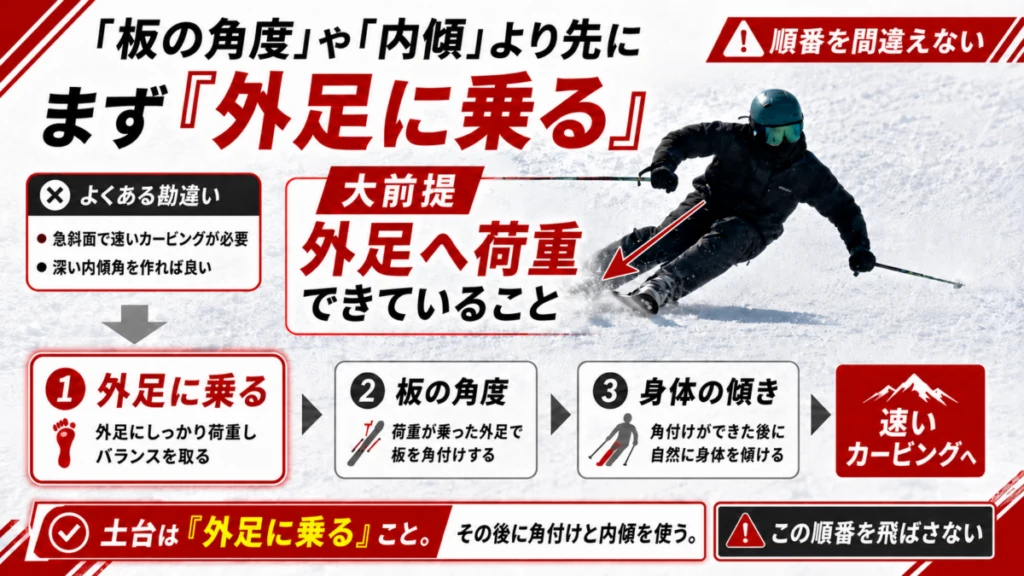
'Once you reach SAJ Level 1 or the Prize Tests, you can't pass unless you can make fast carving turns on steep slopes!'
'People who perform carving turns well create a deep inclination angle when turning!'
And those of you aiming for high-level skiing,
Of course, many people aim to master difficult techniques, but
Wait a moment first!
Both the angle of the skis and the inclination of the body depend on being able to put weight on the outside foot
This is an absolutely fundamental prerequisite!
First, stand on the outside ski.
Once you've established that foundation, use the angle of the skis and the inclination of your body.
Make sure you don't get this order wrong!
So how can you transmit your body weight directly onto the outside foot instead of merely bracing with leg strength?
Starting with Chapter 2, you'll learn the method by actually moving your body.