 Naoki
Hello everyone!
I’m Naoki, a Japanese skier who gives skiing his all for life. I specialize in Japan’s SAJ ski tests and have helped many skiers pass.
This time's content is a sequel to the previous one!
If you haven’t seen the previous article, please go here!
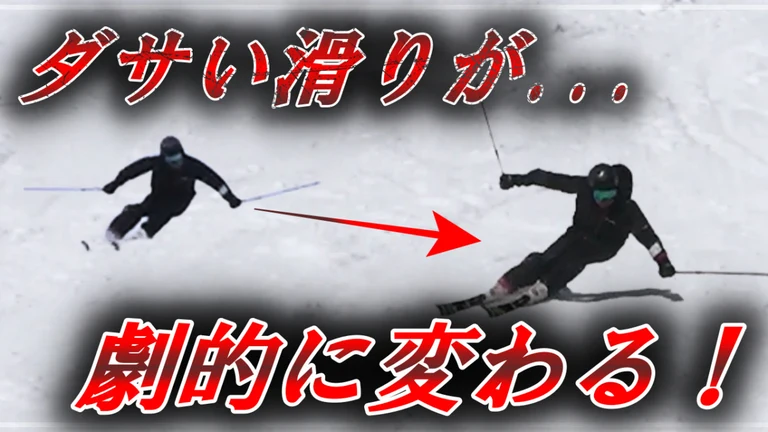
Last time I was talking about the turn on the valley...
This time.
[Fully point at the second part of a turn, after the fall line in the second half of the turn]
I would like to talk about it!
To conclude first,
In the Valley Circuit and the second part of a turn, after the fall line, the ideal height of the turn's foundation is different in position.
That means, you will change the height of the point according to the situation.
That is, if you can control the turn point, you will be able to fully perform the performance of the board!
On the other hand, because I can't do this,
- The silhouette is uncool” ←Go to previous article!
- The board doesn't run
- downhill distance between turns cannot be removed
There are many skiing users who have this problem,
After the Pride Test. 1 So many people can’t get the point?
I think so.
There!
How do you change the high-level valley that you built before?
I want to talk about it in detail!
2 techniques to bring out the skis carrying speed smoothly through and out of the turn with the second part of a turn, after the fall line of skiing
I will also see the video of your M-Consultation!
What do you think?
I think it is better to take another step down the center of mass onto the side of the valley, but this time we will focus on the second part of a turn, after the fall line.
As a premise,
For the Price Test passing, it is necessary to make a "turn to run the board"
That is why the technology needed to go on. 2 and the!
- Control of the fulcrum according to the situation
- Suitable loading the skis while flexing the legs
② Regarding the appropriate loading the skis while flexing the legs,
That’s the “right” thing.
Perhaps this explanation is
I think the basic putting body weight on the skis is a completely different consciousness.
Regarding this "appropriate loading the skis while flexing the legs",
I'll talk more about it next time!
The hint is Not "bending" Yes!
Maybe you don't really understand the meaning (lol)
Don’t worry, think a little before the next update! Have fun to! (^ ^)
So, with that said,
This time.“① Controlling the fulcrum according to the situation” I would like to explain it!
Take a position that won't give in to pressure with Turn the second part of a turn, after the fall line!
First of all, as I explained last time,
Let's review the fulcrum of the turn!
When making a turn with skiing, Where should you apply weight to the snow surface? That's what it means.
So,
This time, how do we change the high fulcrum created around the valley?
I would like to explain this!
The answer is...
In the second part of a turn, after the fall line, the fulcrum is move to a lower position It is.
The second part of a turn, after the fall line is more resistant than the snow side from the direction that rejects against the downward.
This is "pressure from the snow surface."
NaokiThis is the point of how well you can use this pressure from the snow side to run ski!
So, High position of turn fulcrum = position where center of mass is far from the board If it stays that way, it won't be able to withstand the pressure.
For details, see the image from the front and
I will explain with an image seen from the side.
(The picture I saw from the side, because I didn't have a favorite image of the Yummy Fee Demonstration. I agree more than you yourself.
Second half of the turn seen from the front
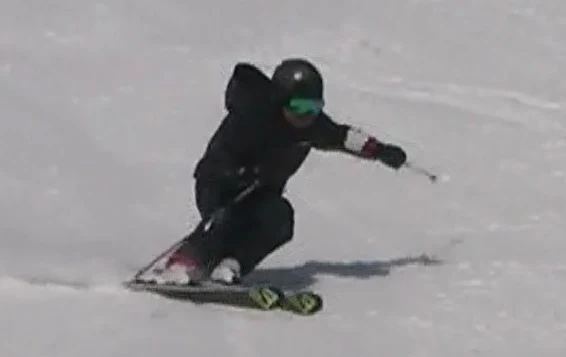
Second half of the turn seen from the side
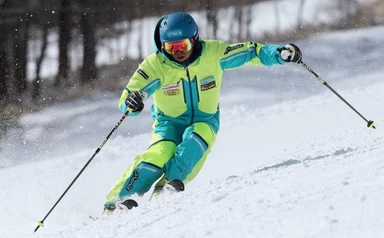
The second part of a turn, after the fall line, is the bottom point.
For reference, here is the image from last time around the valley.
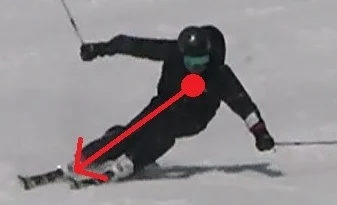
The fulcrum of the turn around the valley is chest to shoulders It was around here!
So how does this change in the second part of a turn, after the fall line?
Let me illustrate this with the image of the second part of a turn, after the fall line mentioned earlier.
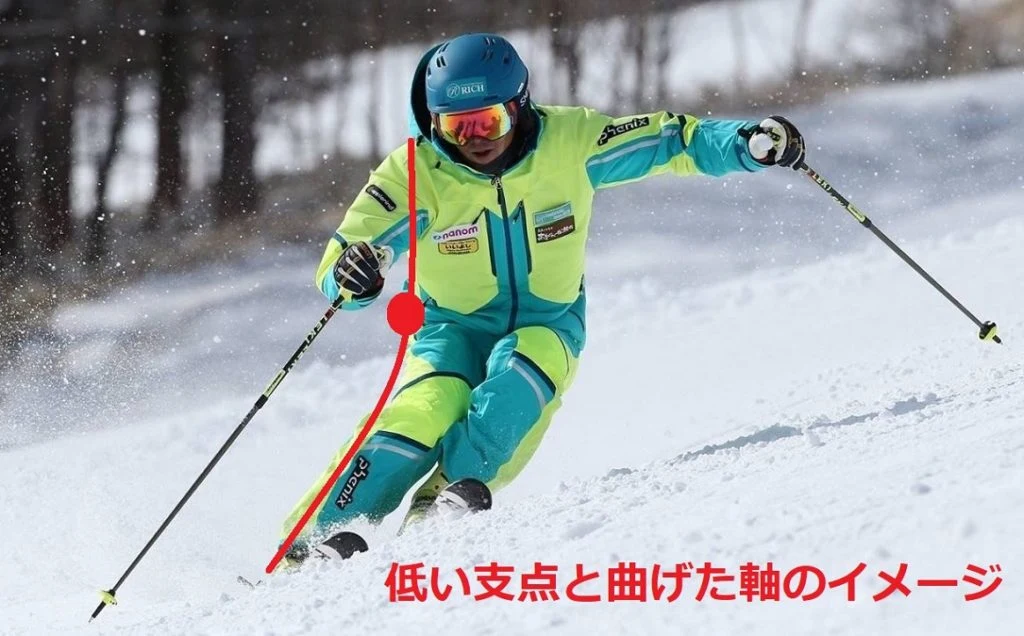
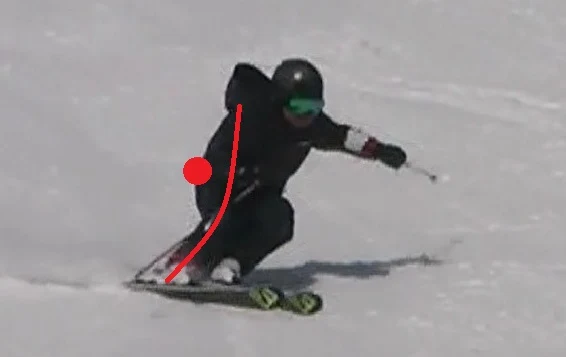
The mouth was in the highest position on the shoulders,
The second part of a turn, after the fall line is moving around the hip/hip joint.
Do you understand?
The reason for moving the fulcrum to a lower position is
By making the axis as a arc, you will be able to accept stronger pressure than high and long. That's right.
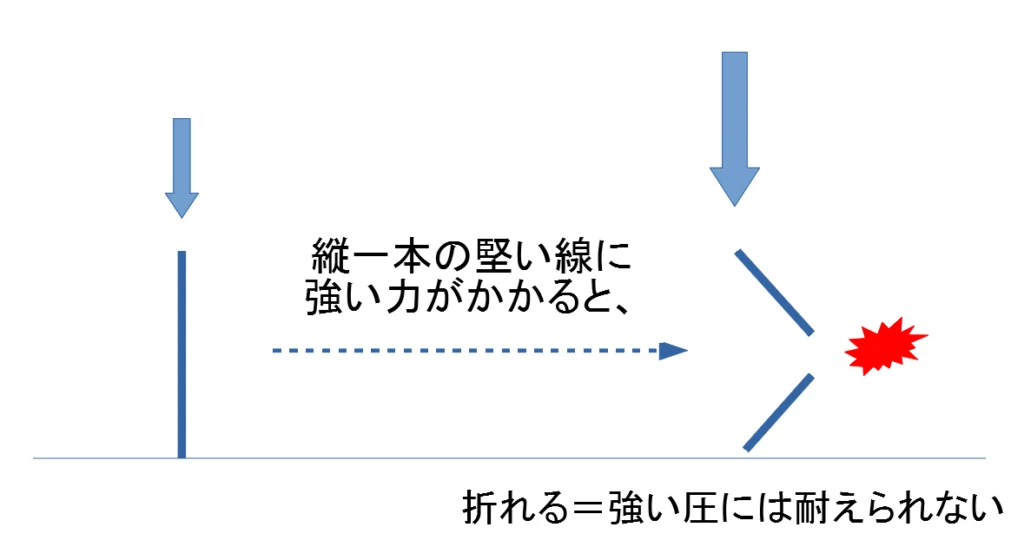
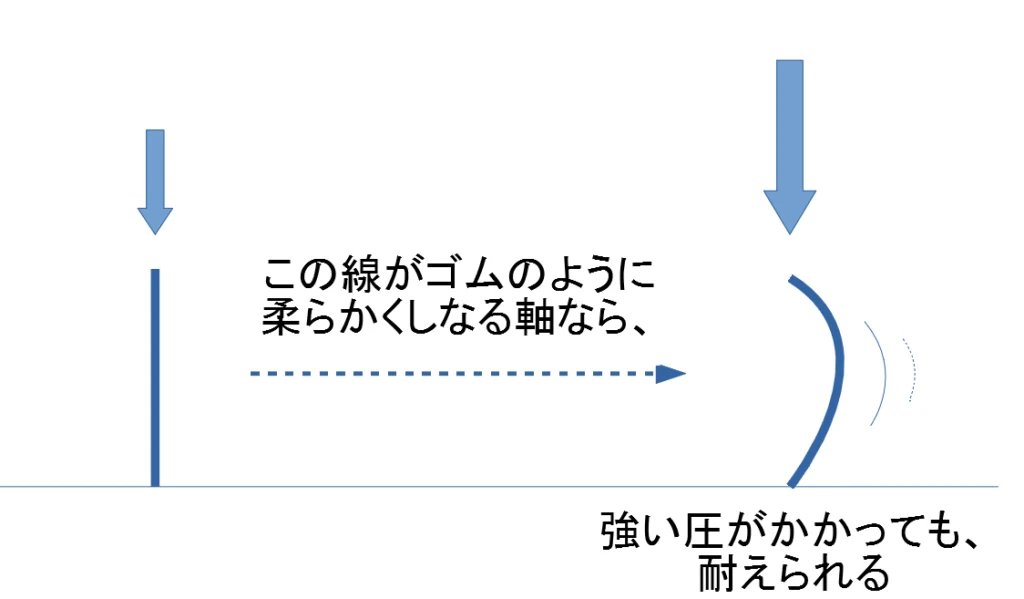
This illustration,
If you're a smart person, you've probably already noticed...
- 1The second picture is the axis where the actual sliding fulcrum is high (image around the valley)
- 2The second axis is a shaft with a low fulcrum (image of the second part of a turn, after the fall line)
is expressed.
The second part of a turn, after the fall line, is stronger as the resistance from the snow surface becomes stronger.
In the second part of a turn, after the fall line, put the point in a low position.
One thing to note here!
The second part of a turn, after the fall line has explained that the point is low, but it’s too strong to know.
Be careful not to carry the weight from your knees.
The legs are bent, but
This is just my opinion from hip / hip joint.
This is related to "loading the skis while flexing the legs" that I explained at the beginning.
By putting body weight on the skis from hip/hip joint, your knees don’t turn by themselves but naturally turns by pressure.
NaokiIf you putting body weight on the skis, it’s actually a natural and foot-motion.
Regarding this,
For more details, see the next “loading the skis while flexing the legs”! (^^)
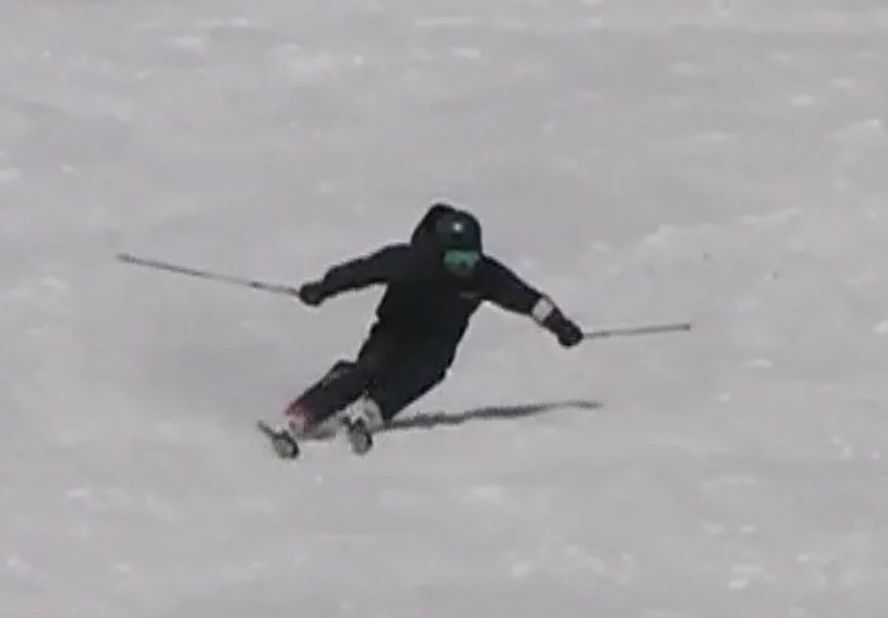
Check the high turn point to break the SAJ Technical/SAJ Crown test!
So this time's theme is
It was to control the height of the point according to the turn situation!
First of all, I have explained
I have briefly summarized the fulcrum of the turn.
- High point: Create a solid axis of one line, showing your body long.
- Low fulcrum: Makes the body axis flexible and absorbs pressure
- Set the fulcrum high around the valley in the first half of the turn.
Lower the fulcrum on the second part of a turn, after the fall line in the latter half of the turn
Let's use this as the basics for now!
Rather than extreme transition up and down, Moving from high to low in a slowly moving position. Let's keep this in mind!
And I forgot you, M.
I think it's about time for me to make a comment about slipping.
(If I don't, I'll get angry lol)
Of course, I will comment on this topic.
First, you have no control over your scale! It does not mean it, right?
Just very expensive,
I think it's a waste.
What I want to say is...
The amount of movement of the fulcrum is small!
That's what it means.
Both the second part of a turn, after the fall line and the valley,
I think it would be nice if they could act more exaggeratedly.
It's not bad, but
If you have Mercury, it feels good!
Especially around the valley, the fulcrum is still high.
It seems like putting body weight on the skis is a little more away from the snow surface.
I felt that the skis carrying speed was smoothly through and out of the turn.
By increasing the width of the fulcrum up and down,
Expand your ``expressive power of sliding''!
The same goes for the silhouette story last time.
This the second part of a turn, after the fall line can also produce sliding properties.
Everything is "Improving expressiveness of sliding" It's for!
Needless to say,
High level skiing skills are essential for high expression, so we must always learn to control this branch.
And one more thing,
For M-kun "Tame" I thought you could have your consciousness!
At the end of the turn, we continue to accept pressure that gradually increases by a repression from the snow side. Never get rid of the pressure and keep on the way.
I read this and say it in the word “sky”. By keeping this stone strong, we will create the bending of the ski and create further running with its freedom.
[Summary] How to bring out the driving performance of skiing with the second part of a turn, after the fall line
Well, this is the summary!
- Move the fulcrum depending on the situation
- the second part of a turn, after the fall line has a flexible shaft to absorb strong pressure.
- In the second half of the turn, move from hip / hip joint to putting body weight on the skis.
- Set the fulcrum high around the valley, and set it low for the second part of a turn, after the fall line.
This time, I have explained about the fulcrum in the second part of a turn, after the fall line.
It may have seemed a little logical, but
I hope you enjoy it!
I think the SAJ Technical turn is needed.
Fulcrum control with the second part of a turn, after the fall line And loading the skis while flexing the legs It's okay if you can!
So next time, I will explain the loading the skis while flexing the legs in a thorough way and end your sliding to pass SAJ Technical!
Be sure to read the previous and next chapters as a set,
You can also get the way you can break the Pride Test!
I read it until the end,
Thank you very much!
See you next time!
感想や質問があればお気軽にどうぞ!
0件のコメント